| Main index | Upside-Down Union Jacks | About author |
Julian D. A. Wiseman
Contents: The Union Jack in PostScript, Description of correct construction, A frequently seen error, Areas of the various parts of the flag, Variations on the 2:1 ratio, Union Jack or Union Flag?, Other files, comment and flags, Afterword.
Publication history: only at www.jdawiseman.com/papers/union-jack/union-jack.html. Usual disclaimer and copyright terms apply.
The flag of the United Kingdom, the Union Jack, is a superposition of the flags of Saint George (for England), Saint Andrew (for Scotland) and Saint Patrick (for Ireland). This superposition is quite intricate, and often drawn incorrectly.
The next diagram shows the correct construction:
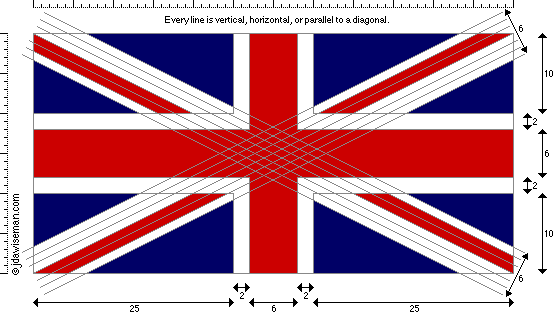
The flag is twice as wide as it is high. The cross of St George is red, and has width equal to one fifth the flag’s height, and a white border of width one fifteenth the height.
The cross of St Andrew is interchanged with that of St Patrick. Start by drawing the diagonals of the whole flag, and then the lines parallel to these that are at a distance of one tenth and one fifteenth the height of the flag. (For clarity the diagram also shows the lines that are apart from the diagonals by only one thirtieth the height.) On the flag-pole side fill red the diagonally orientated area of width one fifteenth the height that lies below the diagonals, and on the non-flag-pole side, the diagonally orientated area of width one fifteenth the height that lies above the diagonals. Finally, fill blue everywhere that is both more than one tenth the height away from the diagonals, and more than one fifteenth the height away from the red of the cross of St George.
The blue should be Pantone 280, approximated here with an RGB setting of 0:0:102, and the red should be Pantone 186, approximated here with 204:0:0. (Thanks for drawing my attention to the colours goes to Graham Bartram, who maintains a site with excellent images of UK flags at www.flags.net/UNKG.htm.)
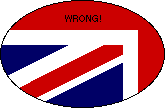
The Union Jack is often drawn incorrectly. The ellipse on the right shows a typical error, in which (wrongly) the cross of St Patrick abuts at a right-angle to the white edge of the cross of St George.
In the 2:1 version of the flag (which is what you want unless you really know otherwise) the four red parts of the cross of St Patrick should always be quadrilaterals. Two of the quadrilaterals have two sides parallel and two perpendicular; the other two have both pairs of non-adjacent sides parallel. The four red parts of the cross of St Patrick should not be pentagons or hexagons, although are often drawn that way.
Another error, seen more frequently, is the hanging of the Union Jack upside down, of which there are examples in Upside-Down Union Jacks.
If the flag is drawn 60 by 30 as in the top diagram, then the various parts have areas as follows. The red of the cross of St George is of area 504 square units. The blue of the cross of St Andrew is in eight pieces, four larger and four smaller. The larger pieces each have area (335–75√5)/2; the smaller each 445/4–30√5; giving a total blue area of 1115–270√5 ≈ 511.261646 square units, which is slightly more than 1.44% larger than the cross of St George. The red of St Patrick is in four pieces, two larger and two smaller, these respectively each having area 20√5 and 20√5–5; for a total of 80√5–10 ≈ 168.8854382 square units. Thus the flag is red : white : blue in the proportions 494+80√5 : 191+190√5 : 1115–270√5 ≈ 37.38% : 34.21% : 28.4%.
The British Army uses a 5:3 version of the flag, which can be drawn by replacing each of the horizontal 25s in the diagram with 20 (example at flagspot.net/flags/gb.html#35). This Army-only flag has the unhappy property that two of the parts of the cross of St Patrick abut at a right-angle to the white edge of the St George, but only just, the extra vertical line having length only 1 part in (5+√34)×25/3 ≈ 90.25793 of the height of the flag. This gives the appearance of a manufacturing error. To avoid this abutting a Union Jack must have a ratio no squarer than 25+2√46 : 21 ≈ 1.836412379345 : 1 ≈ 595 : 324; achievable by replacing the 25s with (9+√46)×10/7 ≈ 22.54618569. It is hoped that any future EU-wide harmonised flag ratio, doubtless imposed to give flags equal ‘flutterability’, will not be squarer than 25+2√46 : 21. To make the vertical line as big as the smallest measurement on the flag, one thirtieth of the height, the flag would have to be as squat as 15+√57 : 16 ≈ 1.4093646522 : 1. If the flag were longer than 25+3√41 : 16 ≈ 2.7630857945 : 1, four of the blue triangles would collide with the white edge of the St George. To make the area of the red of the cross of St George equal to the blue of the cross of St Andrew, the ratio needs to be ≈ 1.9653199433 : 1, this being a root of 0 = 41509r4 – 103332r3 + 47642r2 – 10092r + 949. But, and this is repeated for emphasis, those making or printing a Union Jack should use a ratio of 2:1, except on the clear and unambiguous instruction of Her Majesty’s Government.
The author is occasionally asked which of ‘Union Jack’ and ‘Union Flag’ is the correct name. The Flag Institute answers as follows:
It is often stated that the Union Flag should only be described as the Union Jack when flown in the bows of a warship, but this is a relatively recent idea. From early in its life the Admiralty itself frequently referred to the flag as the Union Jack, whatever its use, and in 1902 an Admiralty Circular announced that Their Lordships had decided that either name could be used officially. Such use was given Parliamentary approval in 1908 when it was stated that “the Union Jack should be regarded as the National flag”.
(The “Parliamentary approval” probably refers to an answer given by The Earl of Crewe on 14th July 1908: “I think it may fairly be stated, in reply to the noble Earl, that the Union Jack should be regarded as the National flag, and it undoubtedly may be flown on land by all His Majesty's subjects.” However, that comment might not have been as definitive as the Flag Institute suggests, as explained at ThePortForum.com.)
Anyway, the Royal Navy disagreed with the Flag Institute:
The national flag of the United Kingdom is worn as a Jack at the bow by all HM ships in commission when alongside or when ‘dressed overall’. This is the only occasion when it is correctly called the Union Jack, although it is generally known by this name through common usage. It is also flown during Courts Martial and is the Distinguishing Flag of an Admiral of the Fleet.
The author enquired of the Royal Navy about this apparent disagreement, asking which of the Flag Institute and the Royal Navy is right? The Naval Historic Branch, of 3-5 Great Scotland Yard London SW1A 2HW, answered as follows:
Both and neither. A jack is a sea flag, a small flag, generally rather square in its proportions, flown from a flagstaff rigged on the bowsprit or stem of the vessel. The earliest known reference to a ‘jack’ of such a type occurs in 1633, the first reference to the Union (rather than the ‘Britain’ or ‘British’ flag) dating from 1625 — the Union Flag and the naval jack are much the same age. The jack was initially simply a particular instance of the Union Flag, but as the distinctive flag of warships it quickly became an exceptionally well-known instance. Technically, all Union Jacks are Union Flags, but not vice versa. It is a fine point and one that was much argued over, but it is beyond question that the habit of treating the two terms as interchangeable developed early, and it would not be difficult to multiply instances of individuals who undoubtedly did understand the distinction nevertheless following common usage and using the term Union Jack when Union Flag is clearly meant.
The RN website is quite right in that the Union Jack flown in the bows of commissioned ships is the only one which really is a jack (unless you count the white-bordered pilot jack), but not quite so on that being the only occasion when it is ‘correctly’ so called — because the Flag Institute is right that the use of Union Jack to mean any Union Flag has been sanctioned both by the Admiralty and by Parliament. Equally, it is questionable to suggest that the distinction between Union Jack and Union Flag is of particularly recent origin — the Union Flag was also employed as a command flag, and there was (and is!) a necessary differentiation to be made, so it is possible that both websites could have chosen their words better, but it would also be difficult to avoid questions like this arising without going into quite inordinate detail.
Make of all that what you will.
Also available on this site is a PostScript version of the Union Jack, and a plain text version suitable for converting to emoticons.
Learned comment on the Union Jack and its many variants can be found at flagspot.net/flags/gb.html, which in turn links to some specifications at flagspot.net/flags/gb-templ.html. Further information on its history and use can be found at the official website of the British Monarchy.
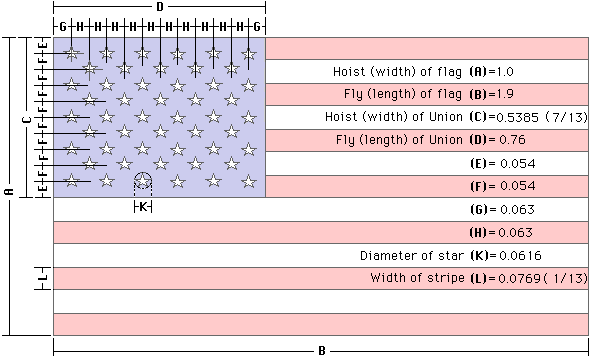
The specification of the geometry of the US flag, though not of the colours, can be found at www.usflag.org (and there is a local copy at www.jdawiseman.com), or at en.wikipedia.org/wiki/Flag_of_the_United_States or at www.law.cornell.edu/uscode/uscode04/usc_sec_04_00000001----000-notes.html. At www.jdawiseman.com is an EPS version of the Stars & Stripes, and a PDF version.
The specification of the geometry of the Australian flag is at www.itsanhonour.gov.au/pdf/flag_template.pdf (local copy).
Julian D. A. Wiseman
November 1999 and subsequent amendments

The following comes from an email sent by Mark Oglesby on 20th June 2012, and the ensuing correspondence.
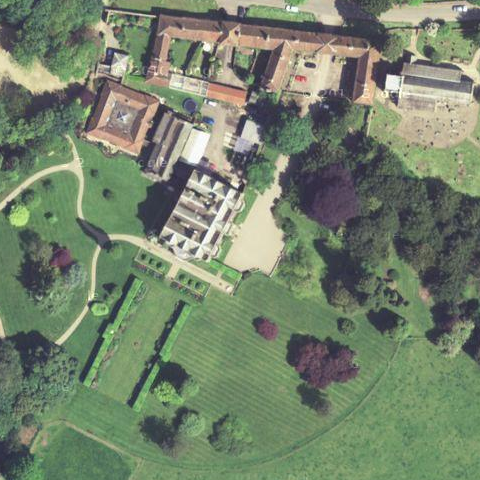
Thank you, your website allowed me to quickly and accurately create this practically inch perfect 5000sq ft union flag at www.goldsboroughhall.com on the 18th June 2012.
… Using your website and with the help of our estate manager to treble check measurements, I had it lined up with the corner of the house, set out and cut in under 4 hours. Using your description it was so easy, 25,2,6,2,25 by 10,2,6,2,10, where the lawn mower cuts 1 wide, having scaled it in my head, I only needed to refer back to your plan to double check the diagonal shapes before cutting them.
To line it with the house, set the centre line first then work out to the corners, …
The hardest part was the lawn mower filled two one-ton builder’s bags with the clippings as this lawn had not seen such short mowing in many years.
The original picture, 1296 × 968, is rather splendid; and the location, though not the flag, is visible on google maps (local copy).
| Main index | Top | About author |